
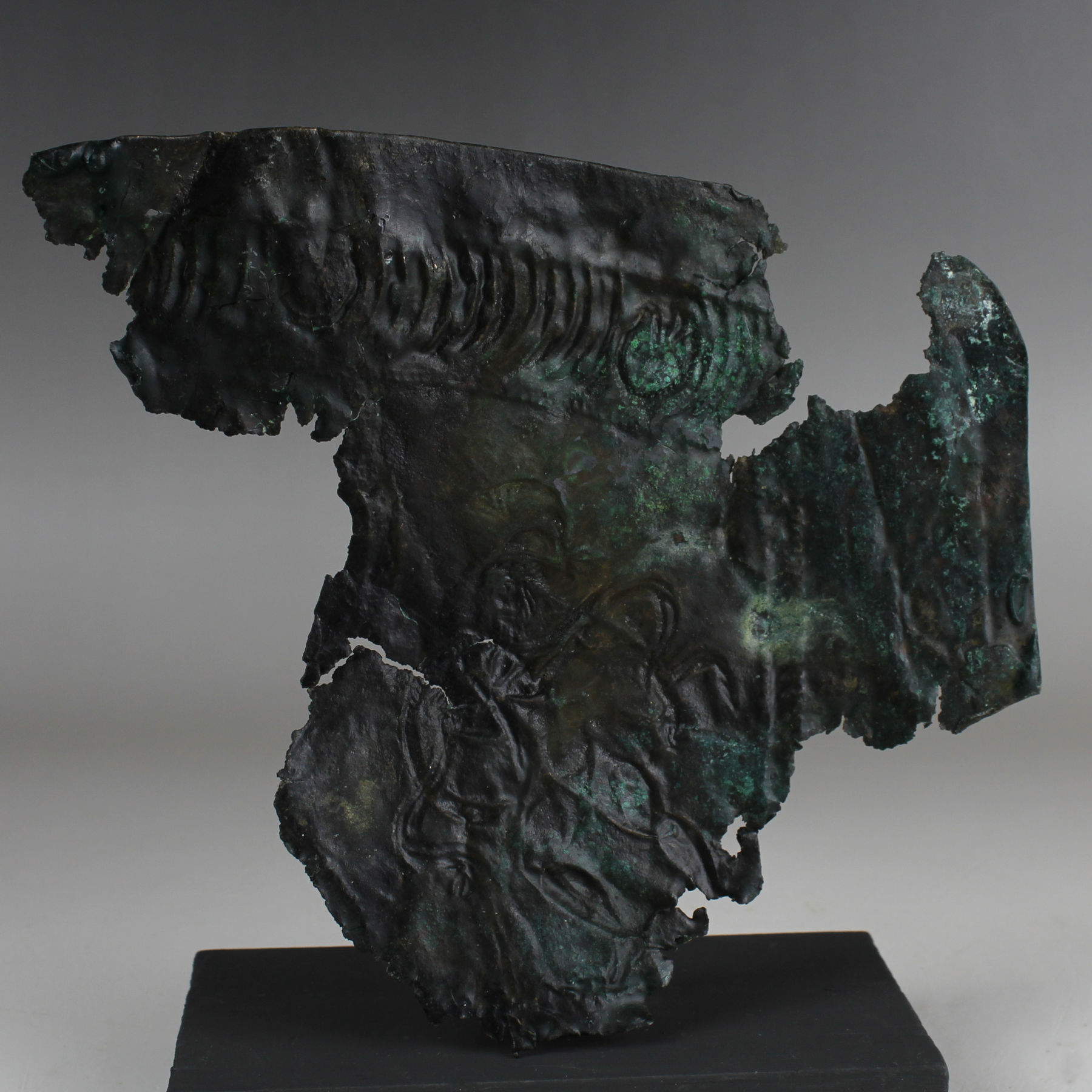
Description
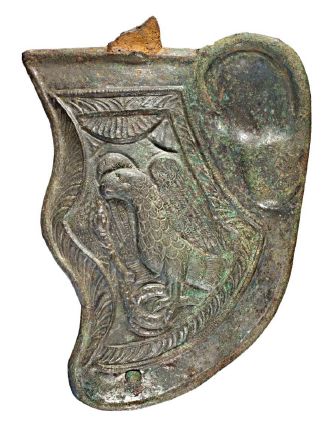
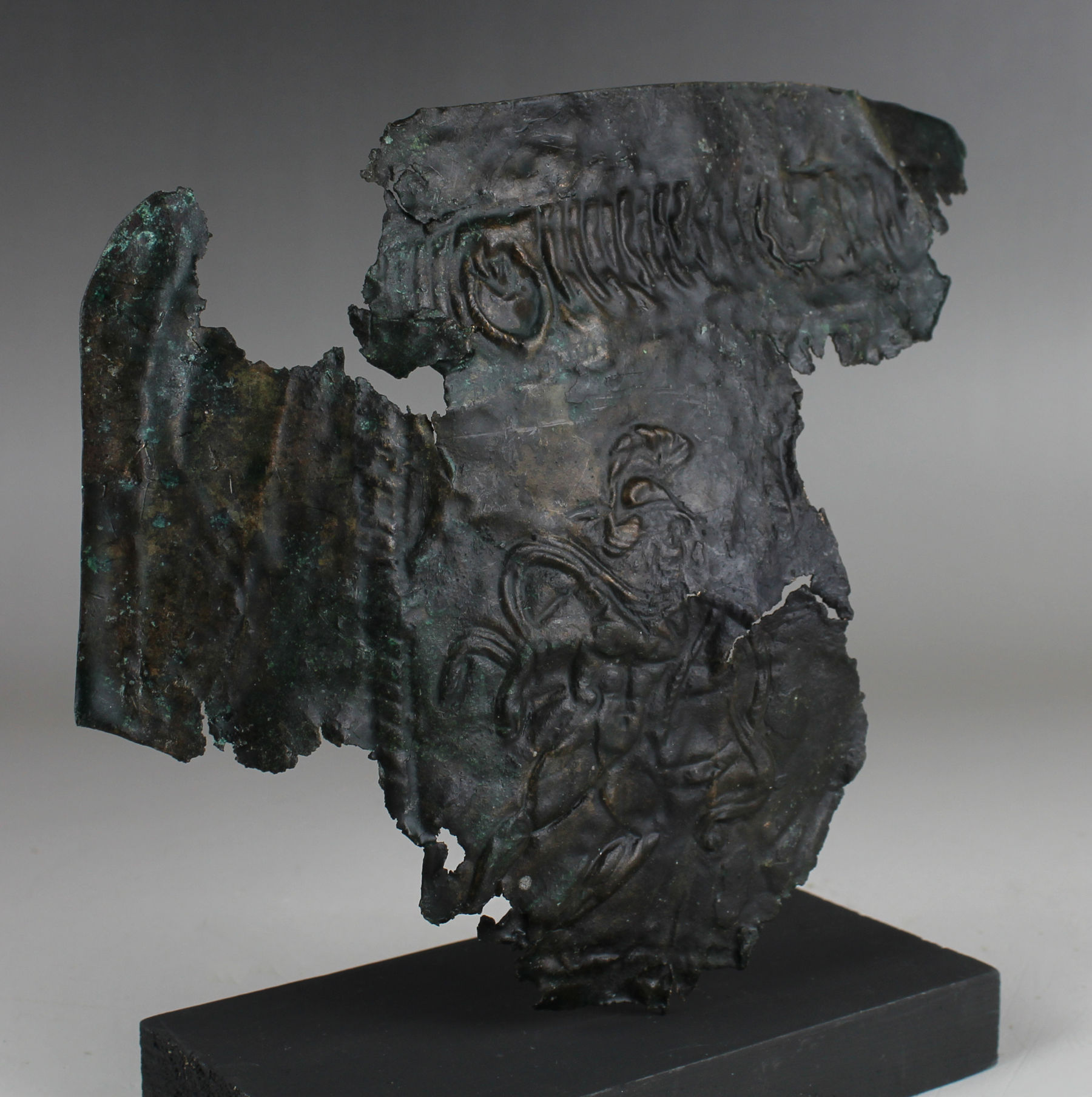
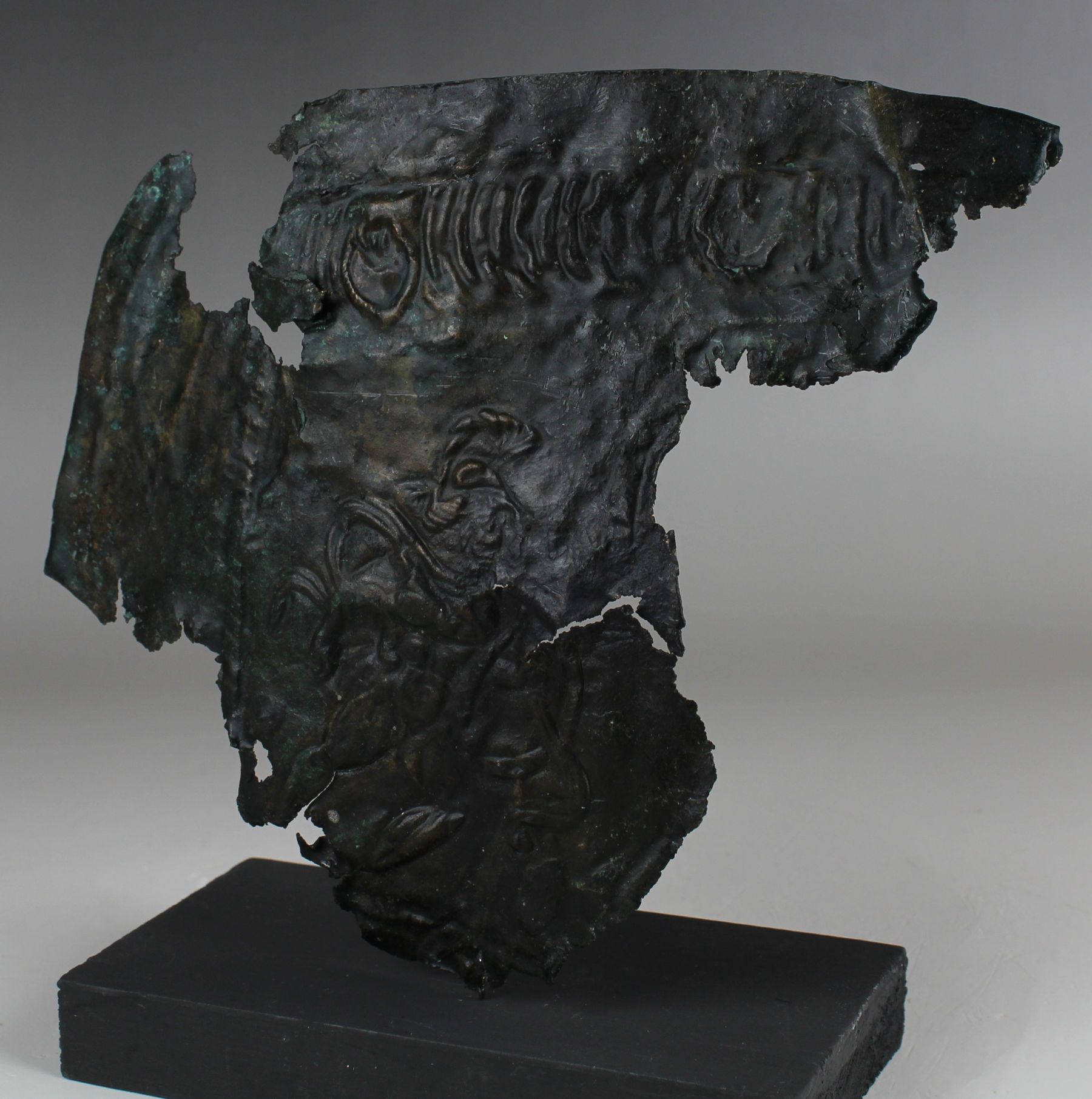
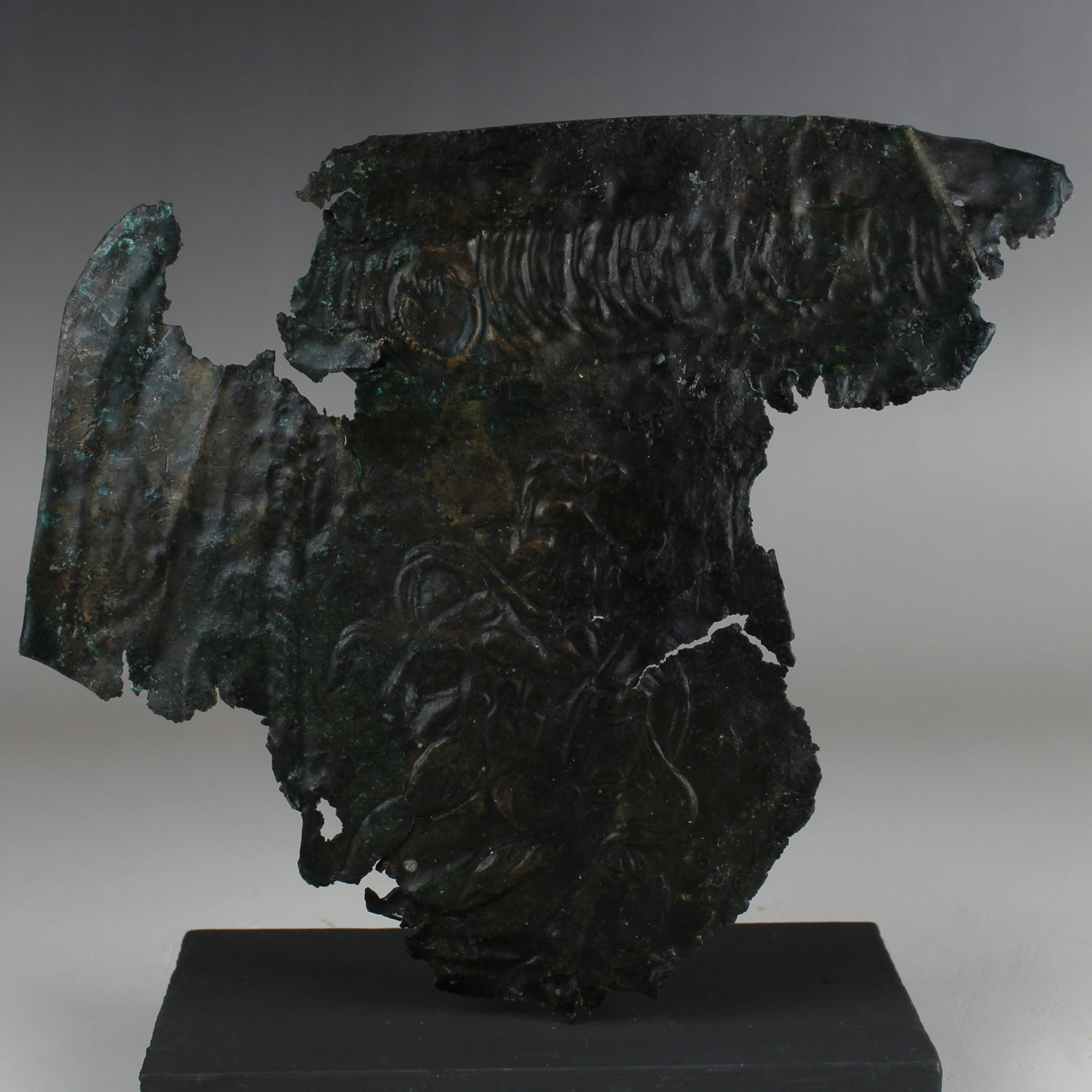
| ITEM | Military mask helmet section depicting Mars |
| MATERIAL | Bronze |
| CULTURE | Roman |
| PERIOD | 3rd Century A.D |
| DIMENSIONS | 155 mm x 180 mm |
| CONDITION | Good condition. Includes a certificate of search in the stolen works of art of Interpol database |
| PROVENANCE | Ex Alison Barker private collection, a retired London barrister, acquired between 1960s – 1990s |
Roman military equipment is famous for its abundance of depictions rife with symbolical content. The so-called cavalry sports equipment, which used to be seen as being solely parade armour, can be distinguished from the infantry equipment not only by its function, but also by its design. There are numerous surviving heavily ornamented parts of Roman cavalry equipment and a number of studies have been published on their purpose and decoration. Whether the ornamented equipment belonged to parade armour or was also worn in battle is still under discussion. One of those groups contains the helmets, of which a relatively large number of different variations exist. Apart from the calotte with its neck guard, the loosely attached cheek pieces were also an essential part of the helmet. Cheek pieces as protective elements were used both for infantry and cavalry helmets. Although in some cases it is still difficult to attribute individual examples to the cavalry, due to the higher amount of remains we can be relatively certain that the majority of helmets did indeed belong to the cavalry.
In Roman mythology, Mars was the god of war and one of the most prominent and worshipped deities in the Roman pantheon. Unlike his Greek counterpart, Ares, who was often viewed with suspicion as a destructive and destabilizing force, Mars was revered as a virtuous guardian of the Roman state. He was considered the father of the Roman people through his sons, Romulus and Remus, the legendary founders of Rome. This ancestral connection elevated him from a mere god of combat to a foundational figure of civic pride and Roman identity, representing military power used to achieve lasting peace.
As the son of Jupiter and Juno, Mars held a central place in the “Capitoline Triad” in early Roman tradition and was second in importance only to Jupiter. His influence extended beyond the battlefield; he was originally associated with agriculture and the protection of cattle, embodying the dual nature of the Roman citizen-soldier who moved between the plow and the sword. The month of March (Martius) is named in his honor, marking the time of year when both the agricultural season resumed and military campaigns typically began.
Mars was often depicted as a mature man in full battle regalia, wearing a crested helmet and carrying a spear or shield. He was frequently accompanied by personifications of the consequences of war, such as Bellona (the goddess of war) or his sons Phobos (Fear) and Deimos (Terror). His most famous temple, the Temple of Mars Ultor (Mars the Avenger), was built by Augustus in the Forum Augustum to commemorate the defeat of Caesar’s assassins. To the Romans, Mars was not just the fury of the fight, but the disciplined strength and tactical brilliance that ensured the expansion and security of their vast empire.